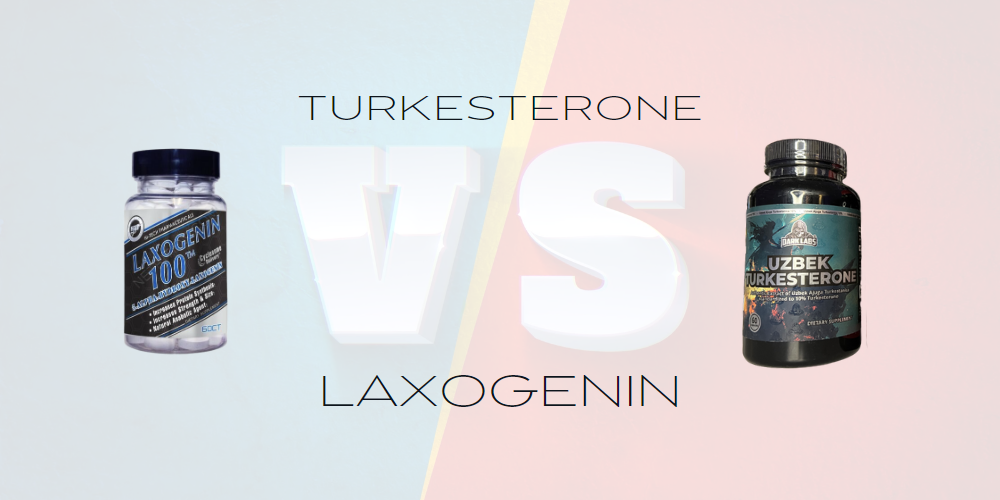
If forced to rank them, turkesterone has the less unfavorable evidence profile. That is not a recommendation to buy it. It means limited, mostly null human evidence is still more informative than no controlled human outcome evidence plus an FDA enforcement concern.
| Question | Turkesterone | Laxogenin / 5α-hydroxy-laxogenin | Winner |
|---|---|---|---|
| Controlled human outcome research | Several small studies; results mostly null | No controlled human efficacy trial found | Turkesterone |
| Human muscle-growth evidence | No convincing lean-mass benefit | None | Neither |
| Human strength evidence | No convincing benefit | None | Neither |
| Testosterone evidence | No reliable increase shown | No human evidence | Neither |
| Mechanistic evidence | Cell and animal hypotheses do not establish human results | Androgen-receptor activation in cells, but no anabolic or androgenic effect in a 2025 rat model | Neither |
| Evidence-based dose | Not established | Not established | Neither |
| Human safety record | Limited; long-term safety not established | Inadequately characterized | Turkesterone, by a narrow margin |
| U.S. supplement status | No comparable FDA finding identified in this review | FDA says 5α-hydroxy-laxogenin is not a dietary ingredient and is an unsafe food additive under the marketed conditions it addressed | Turkesterone |
| Tested-athlete risk | Product-quality and evolving-status risk | High-risk product category, labeling ambiguity and contamination concerns | Neither |
| Overall recommendation | Not recommended for expected muscle gain | Avoid | Neither |
A fair comparison starts with chemistry and labeling rather than marketing names.
Laxogenin is a naturally occurring spirostane-type plant steroid. A steroidal chemical structure does not automatically make a compound an anabolic-androgenic steroid or prove that oral supplementation builds muscle.
Most bodybuilding supplements that use “laxogenin” language have referred to 5α-hydroxy-laxogenin, also written as 5-alpha-hydroxy-laxogenin, 5a-hydroxy-laxogenin, or 5-laxogenin.
That derivative should not be treated as interchangeable with plant laxogenin. Analytical research has described 5α-hydroxy-laxogenin as synthetic rather than a naturally occurring plant compound.[4][5]
Some products use overlapping terms such as 6-keto diosgenin, laxogenin acetate, decanoate, undecanoate, or other steroid-like ester names. Similar naming does not prove identical chemistry, absorption, duration, or biological action.
A study on 5α-hydroxy-laxogenin does not automatically validate every product labeled “laxogenin.” The reverse is also true: a vague label should not be presumed safer merely because it avoids the exact FDA-listed name.
The finished product needs an exact ingredient identity, CAS number, batch certificate, and independent analytical testing before its evidence can even be matched correctly.
Turkesterone is a phytoecdysteroid found in plants such as Ajuga turkestanica. Its reputation as a natural anabolic grew largely from cell, animal, and broader ecdysteroid research.
That evidence created a hypothesis worth testing. It did not prove that commercial turkesterone capsules build muscle in people.
A 2024 randomized investigation assigned 31 active men and women to 500 mg of turkesterone or placebo daily for four weeks. Researchers used DXA to assess body composition.
Turkesterone did not outperform placebo for body mass, lean body mass, fat mass, or body-fat percentage.[1]
Four weeks is short, and the study was small. Those limitations prevent a definitive statement that turkesterone can never work. They do not justify reversing the result and calling it effective.
A separate crossover study gave 11 healthy men an acute 1,000 mg dose, 2,000 mg dose, or placebo. Neither dose significantly changed serum IGF-1, resting metabolic rate, carbohydrate oxidation, or fat oxidation relative to placebo.[2]
The doses did not significantly affect resting heart rate, blood pressure, or reported gastrointestinal symptoms during the short observation period. That supports acute tolerability in a very small sample—not long-term safety or muscle growth.
A 2025 double-blind trial of a commercial ecdysteroid supplement also failed to show meaningful advantages for body composition, handgrip strength, mood, or sleep over four weeks.[3]
A branded blend is not identical to pure turkesterone, so it should not be used as the sole verdict on the isolated compound. It does, however, add to a pattern: the human studies available so far have not reproduced the dramatic anabolic claims used in marketing.
No controlled human trial found in this review demonstrated that oral laxogenin or 5α-hydroxy-laxogenin improves lean mass, strength, recovery, testosterone, or athletic performance.
The available evidence is preclinical and analytical.
A 1976 study tested several 6-keto derivatives of natural sapogenins in rats. One derivative increased body weight and selected tissue measurements without androgenic activity in that model.[6]
This study is repeatedly cited to support modern laxogenin products, but it does not establish that:
It is hypothesis-generating animal evidence, not human product validation.
A 2022 study found that 5α-hydroxy-laxogenin could bind to and activate the androgen receptor in a cell-based assay.[4]
That sounds compelling in marketing copy, but receptor activity in a laboratory system is not the same as an anabolic effect in a living organism. Absorption, metabolism, tissue exposure, dose, and downstream physiology can prevent an in-vitro signal from producing a practical result.
Researchers tested three doses of 5α-hydroxy-laxogenin for two weeks in orchiectomized rats. They found no increase in androgen-responsive tissues, the levator ani muscle, or hindlimb muscles. At the highest dose, some tissues showed greater atrophy rather than growth.[5]
The study used subcutaneous administration and an animal model, so it cannot establish the effects of oral use in people. It does directly challenge the assumption that the cell-based androgen-receptor signal translates into anabolic activity.
A 2026 paper identified metabolites of 5α-hydroxy-laxogenin in human liver cells and a rat model. The work may help future analytical screening, but it did not show improved human muscle growth, strength, or recovery.[7]
The authors noted that available performance and health-risk data did not yet justify WADA prohibition at the time of publication. That is not a finding that the ingredient is safe, legal to sell as a U.S. dietary supplement, or effective.
Neither has earned a muscle-building recommendation.
Turkesterone has the stronger evidence base only because researchers have performed controlled human studies. Those studies have not shown a convincing increase in lean mass.
Laxogenin has no controlled human muscle-growth evidence. The newer animal work on 5α-hydroxy-laxogenin also failed to confirm an anabolic effect.
Muscle-growth winner: neither.
Turkesterone ranks ahead on evidence quality, not demonstrated efficacy.
No reliable evidence shows that either ingredient meaningfully increases human strength.
Turkesterone studies have not established a repeatable advantage in strength outcomes. Laxogenin has no controlled human strength trial.
For strength, progressive training, adequate calories and protein, sufficient sleep, and creatine have a substantially stronger evidence base.
Strength winner: neither.
Recovery claims for both ingredients are mostly indirect.
A compound might affect a signaling pathway in cells or an animal model without reducing human soreness, restoring force production, improving sleep, or increasing training readiness. Those practical recovery outcomes need to be measured directly.
No convincing controlled evidence shows that turkesterone or laxogenin improves recovery enough to recommend either one.
Recovery winner: neither.
Neither ingredient has reliable human evidence showing a clinically meaningful testosterone increase.
Turkesterone is not testosterone and should not be sold as a natural testosterone replacement. Laxogenin’s steroidal structure and the in-vitro androgen-receptor finding do not prove that it raises testosterone.
A supplement can interact with a biological pathway without increasing total testosterone, free testosterone, luteinizing hormone, or fertility-related outcomes.
Testosterone winner: neither.
The small human studies provide limited short-term information. One acute study found no significant change in resting blood pressure, heart rate, or gastrointestinal symptoms after 1,000 or 2,000 mg.[2]
That does not answer:
Turkesterone should be described as insufficiently characterized, not proven safe.
Human safety is even less defined for 5α-hydroxy-laxogenin.
The absence of published human adverse-event trials is not reassuring when controlled exposure data are missing. Additional concerns include unlawful use in U.S. supplements, inconsistent labeling, synthetic material marketed as natural, and overlap with high-risk bodybuilding products.
USADA has reported that products on its high-risk list which declared laxogenin also frequently listed a prohibited substance or tested positive for an undeclared stimulant, anabolic steroid, or SARM.[10]
That observation does not prove every laxogenin product is adulterated. It makes the category unsuitable for confident safety or drug-testing assurances.
Safety winner: turkesterone by a narrow margin, but neither has a strong long-term safety record.
The U.S. FDA has specifically stated that 5α-hydroxy-laxogenin does not qualify as a dietary ingredient, is not generally recognized as safe for its intended use, and causes a product containing it to be adulterated as an unsafe food additive.[8]
The FDA ingredient directory continues to list 5α-hydroxy-laxogenin and aliases including 5-laxogenin, decanoate, and undecanoate forms with links to agency actions.[9]
This needs precise wording:
Turkesterone does not have the same specific FDA finding in the sources reviewed for this article. That does not mean the FDA has approved it for effectiveness or confirmed every marketed turkesterone product as lawful and safe.
At the time of the 2026 metabolism publication, 5α-hydroxy-laxogenin was not prohibited by WADA because available data did not satisfy the criteria for inclusion.[7]
That status should not be translated into “drug-test safe.”
Turkesterone also sits in a muscle-building category where product identity and ecdysteroid status require caution. Do not assume that turkesterone and ecdysterone have identical rules or detection profiles.
USADA recommends that athletes who use supplements choose products certified by a recognized third-party sport program, while noting that certification reduces rather than eliminates risk.[11]
Tested-athlete verdict: avoid laxogenin products and do not use turkesterone without current sport-specific guidance and batch certification.
No evidence-based muscle-building dose has been established for either ingredient.
For turkesterone:
Those are study doses, not recommendations. A null result at a given dose does not prove that a higher dose works or is safe.
For laxogenin, product-label amounts and bodybuilding cycles are not supported by controlled human dose-response research. Ester names do not supply missing pharmacokinetic evidence.
A precise “best dose” would create confidence the research does not justify.
There is no controlled evidence that the combination is synergistic, safer, or more effective than either ingredient alone.
The stack usually rests on two unproven assumptions:
Current evidence supports neither premise.
Stacking also makes it harder to identify adverse effects, label inaccuracies, or the source of a positive drug test. The rational answer is not to combine two uncertain products in the hope that weak evidence becomes strong evidence.
The right alternative depends on the goal.
Prioritize:
A better-supported ingredient may still require safety screening and realistic expectations. The current evidence comparison between ashwagandha and turkesterone explains why ashwagandha has a more defensible use case without treating it as a steroid substitute.
Do not use an experimental supplement as a diagnostic test or substitute for medical evaluation. Symptoms attributed to “low testosterone” can have multiple causes and need appropriate assessment.
Neither turkesterone nor laxogenin offers a favorable evidence-to-cost ratio for muscle gain.
Turkesterone has limited direct human research. That is better than relying entirely on cells and animals, but the studies available so far are mostly null and do not establish a useful bodybuilding dose.
The case for laxogenin is weaker. The commonly marketed 5α-hydroxy derivative has no controlled human efficacy trial, did not show anabolic or androgenic effects in a recent rat model, and has a direct FDA regulatory problem in U.S. supplements.
Final ranking:
This is not a close contest between two proven options. It is a comparison between an inadequately supported ingredient and an even less defensible one.