That does not make ashwagandha a natural anabolic steroid. Its likely value is indirect and context-dependent—especially when stress or poor sleep is limiting training. If the goal is reliable muscle gain, neither ingredient should replace progressive training, sufficient protein and calories, sleep, or better-supported performance supplements.
| Category | Turkesterone | Ashwagandha |
|---|---|---|
| What it is | A phytoecdysteroid commonly sourced from Ajuga turkestanica extracts | A botanical extract from Withania somnifera |
| Main marketing claim | Natural anabolic, lean mass and strength | Stress, sleep, recovery, testosterone and performance support |
| Direct human evidence | Preliminary and mostly null | Multiple trials plus recent meta-analyses, although results are heterogeneous |
| Muscle-growth evidence | No convincing direct human benefit demonstrated | Some positive training trials, but not consistent enough to call it an anabolic |
| Strength evidence | No clear benefit in short human studies | Possible modest benefit; certainty varies by outcome and trial |
| Stress/sleep evidence | No established benefit | Better-supported use, especially for stress and some sleep outcomes |
| Evidence-based dose | Not established | Many exercise studies use 500–600 mg/day of a standardized extract; product-specific standardization matters |
| Long-term safety | Poorly characterized | Better described for short-term use, but long-term safety remains uncertain |
| Best use case | None clearly established | Stress/recovery support when an appropriate user can take it safely |
| FitFrek verdict | Experimental; not recommended for muscle gain | Clear winner, but with measured expectations |
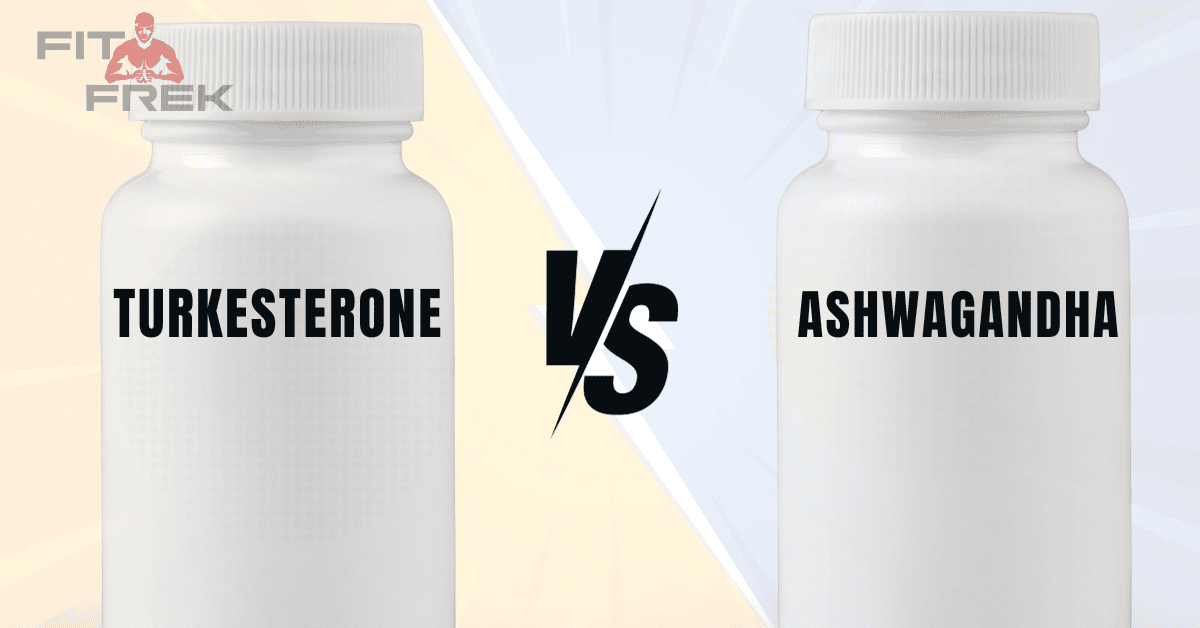
Turkesterone and ashwagandha are often compared because both are sold to lifters, but their evidence and intended uses are different.
Turkesterone is marketed as a non-hormonal anabolic compound. The promise is usually direct: more protein synthesis, faster muscle growth, better recovery, and steroid-like results without androgenic side effects.
Ashwagandha is primarily an adaptogenic herb. Its strongest practical case is not direct anabolism. It is the possibility that reducing stress, improving sleep, or supporting recovery could help a person train more consistently. Some resistance-training trials also report strength or body-composition improvements, but the overall exercise literature is not uniformly positive.
A fair comparison therefore asks two questions:
Ashwagandha has the better answer to both, but especially the second.
The older version of this article treated turkesterone's muscle-building effects as established. The current human evidence does not support that confidence.
A small randomized crossover study gave 11 healthy men single 1,000 mg and 2,000 mg doses of turkesterone or placebo. Researchers measured IGF-1, resting metabolic rate, substrate use, heart rate, blood pressure, and short-term tolerability.
The study found no statistically significant condition effects for IGF-1, resting metabolism, or fuel use.[1]
This does not prove turkesterone can never affect muscle over months. It does show that large acute doses did not produce the short-term anabolic or metabolic signal often implied by marketing.
A randomized placebo-controlled study followed 31 active men and women taking 500 mg/day of turkesterone for four weeks. It found no between-group benefit for body mass, lean mass, fat mass, body-fat percentage, or handgrip strength.[2]
Four weeks may be too short to detect a small hypertrophy effect. But this remains direct human evidence, and it was negative—not proof that a longer cycle works.
A separate double-blind trial tested a turkesterone-containing product for four weeks. It found no significant group differences in body composition, handgrip strength, mood, or sleep.[3]
Because this was a branded multi-ingredient or commercial product context, it should not be treated as a perfect isolated-turkesterone experiment. It still adds no positive human support for the marketed outcome.
The direct human literature is small, short, and not definitive. But the available results lean null rather than positive.
Claims built from insect physiology, rodent work, cell studies, or research on other ecdysteroids should not be presented as proof that oral turkesterone builds human muscle.
Turkesterone evidence grade for muscle or strength: very low.
Ashwagandha has a larger and more relevant human evidence base, but the strongest version of the claim is still often exaggerated.
A 2015 randomized, double-blind trial enrolled 57 healthy men with limited resistance-training experience. Participants used 300 mg of a standardized root extract twice daily or placebo for eight weeks while following a training program.
The ashwagandha group showed greater improvements in selected strength, muscle-size, body-composition, testosterone, and recovery outcomes.[4]
This is encouraging, but it was one modest-sized trial in novice male lifters using a specific extract and training protocol.
A later randomized trial studied 600 mg/day of standardized root extract in 80 physically active men and women during eight weeks of resistance training. The ashwagandha group improved more on several strength, endurance, and body-circumference outcomes, with no adverse events reported in the study.[5]
Circumference changes are less precise than imaging-based muscle measurements, and one trial cannot establish a universal effect. It does broaden the evidence beyond novice men.
A 2026 meta-analysis pooled 13 randomized trials involving 599 participants. Ashwagandha improved overall exercise performance on average, but the results varied substantially and the prediction interval crossed zero. Aerobic endurance had the most consistent signal. Strength effects were positive but uncertain, while power and muscular-endurance evidence remained sparse.[6]
The review described 500–600 mg/day as the most evidence-supported extract range, but those dose findings were exploratory—not a universal prescription.
The U.S. National Center for Complementary and Integrative Health says some preparations may help stress and insomnia. It considers testosterone evidence limited and says there is still not enough evidence to determine whether ashwagandha helps athletic performance overall.[7]
That conclusion is more conservative than some recent sports meta-analyses, but it highlights the correct uncertainty: the evidence is promising in places, not settled.
Ashwagandha evidence grade for exercise support: low to moderate, depending on the outcome.
Ashwagandha wins, but not because it has been proven to work like an anabolic agent.
Turkesterone has no convincing positive direct human result for lean mass. The best available short trials have been null.
Ashwagandha has several positive training studies and meta-analytic support for some performance outcomes. However:
For a muscle-building article, the accurate conclusion is:
Ashwagandha has a plausible, human-supported training role. Turkesterone does not yet have a demonstrated human anabolic role. Neither should be marketed as a steroid substitute.
Ashwagandha again has the stronger case.
The turkesterone studies did not show an advantage in handgrip strength, and there is no strong training trial showing a meaningful increase in compound-lift strength.
Ashwagandha trials have reported improvements in bench press, leg-extension or leg-press measures, handgrip, and selected athletic outcomes. The 2026 meta-analysis found the average strength effect positive but uncertain, which means the benefit should be described as possible rather than guaranteed.[6]
If strength is the only goal, the expected effect of training design, technique, nutrition, creatine, and recovery is much more reliable than choosing between these two supplements.
Ashwagandha has limited human evidence suggesting it may raise testosterone in some populations, including certain stressed, infertile, or resistance-training groups. NCCIH still categorizes the evidence as limited.[7]
That does not mean:
No convincing controlled human evidence shows that turkesterone increases testosterone. Its marketing usually claims a non-androgenic pathway, so presenting it as a testosterone booster is internally inconsistent as well as unsupported.
Winner: Ashwagandha, but the testosterone claim should remain secondary and qualified.
Ashwagandha wins by a wide margin.
Stress and some insomnia outcomes are among its better-supported uses. That can matter to lifters because poor sleep, high stress, and inconsistent recovery can reduce training quality even when a supplement has no direct anabolic effect.[7]
Turkesterone has no established stress-management benefit. A four-week study found no significant improvement in sleep quality, and product-level evidence has not shown a reliable mood or recovery advantage.[3]
The practical use case for ashwagandha is therefore clearer:
There is no evidence-based bodybuilding dose.
Human studies have tested 500 mg/day for four weeks and acute doses of 1,000–2,000 mg, without demonstrating the marketed muscle-building outcome.[1][2]
Those studies establish tested amounts, not an effective dose. Increasing the dose because a smaller study was negative is not evidence-based.
Label numbers are also difficult to compare because products may list:
A “500 mg capsule” does not necessarily contain 500 mg of isolated turkesterone.
Many modern exercise studies use around 500–600 mg/day of a standardized extract, often split into two doses.[4][5][6]
That does not make every 600 mg product equivalent. Important variables include:
Use the product label and clinician guidance rather than treating 600 mg as universally appropriate.
Human safety evidence is limited. One small acute study found no meaningful short-term changes in measured blood pressure, heart rate, or gastrointestinal tolerability up to 2,000 mg, but a single exposure does not establish long-term safety.[1]
Unknowns include:
Ashwagandha is better characterized but not risk-free.
NCCIH states that some preparations may be safe for short-term use up to about three months, while long-term safety is uncertain. Reported concerns include drowsiness, gastrointestinal symptoms, rare liver injury, medication interactions, and possible effects on thyroid or immune function.[7]
NCCIH advises avoiding it during pregnancy and breastfeeding and recommends caution around surgery, autoimmune or thyroid disorders, hormone-sensitive prostate cancer, and medications for diabetes, blood pressure, seizures, sedation, immune suppression, or thyroid function.[7]
Safety winner: Ashwagandha has more human information, not an all-clear.
There is no good evidence that the combination is synergistic.
The old argument is that turkesterone directly builds muscle while ashwagandha supports testosterone and recovery. That stack logic assumes the first claim is true, which current human research has not shown.
Combining them also makes side effects and product-quality problems harder to identify. A better approach is to choose one intervention for a defined reason, track a relevant outcome, and avoid adding an experimental ingredient without evidence of added benefit.
Ecdysteroids are an active anti-doping research area. Status can change, and turkesterone should not be assumed to have the same status or metabolism as ecdysterone merely because both are phytoecdysteroids.
The larger practical risk is supplement quality. Muscle-building products are a high-risk category for contamination or undeclared ingredients. Tested athletes should:
Ashwagandha itself is not generally treated as an anabolic agent, but the finished product still needs quality control.
Ashwagandha is the more rational option if:
Only someone who:
That is a narrow group. For most readers, the evidence does not justify the purchase.
Ashwagandha is the clear winner.
It has multiple controlled human trials, recent meta-analyses, and a realistic use case centered on stress, sleep, recovery, and possibly modest performance support. Its evidence is still mixed, extract-specific, and accompanied by real safety cautions.
Turkesterone's direct human studies are small, but they have not shown the lean-mass, strength, IGF-1, or recovery benefits used to sell it. There is no validated muscle-building dose and no strong long-term safety record.
Choose ashwagandha only when its use case and safety profile fit you. Do not choose turkesterone on the promise of steroid-like gains.