5/3/1 BBB pairs the main 5/3/1 work with purposeful 5×10 supplemental volume. The downloads below are blank FitFrek tools—not copied Jim Wendler programming, a public editable sheet, or an unauthorized 5/3/1 Forever PDF.
On this page
Quick Verdict
Decision summaryBest fit
Want strength + size around the squat, bench, deadlift, and press.
How it works
Main 5/3/1 work, then 5×10 supplemental volume from one clearly identified BBB version.
Biggest risk
An inflated training max or extra assistance turns a simple template into a recovery problem.
Downloads
FitFrek provides a blank calculator and private training log—not copied 5/3/1 programming.
XLSX calculator
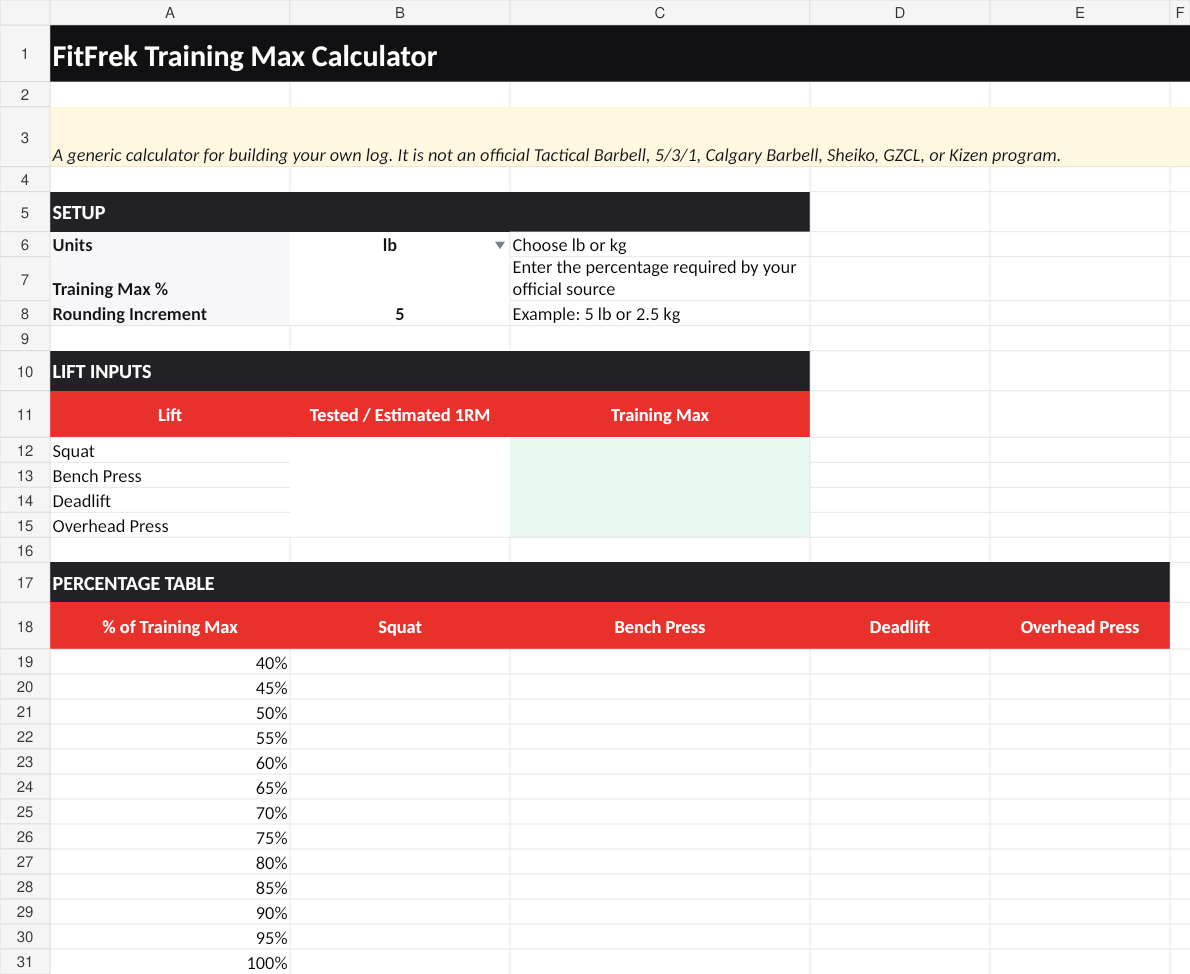
FitFrek Training-Max Calculator
Blank calculator with user-entered training-max percentage and rounding
Enter the percentage required by the official 5/3/1 source you are following. The workbook does not choose the programming rule for you.
XLSX training log
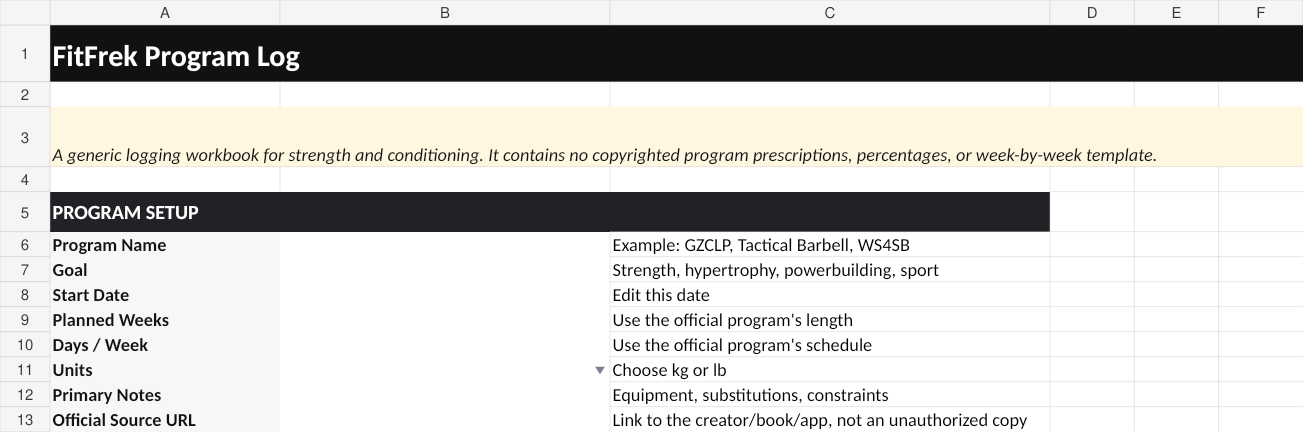
FitFrek Program Log
Generic strength, conditioning, and progress tracker
Enter only the sessions prescribed by the 5/3/1 source and BBB variation you selected. No Jim Wendler programming is embedded in the file.
Program Overview
At a glanceFoundation
CreatorJim Wendler
Base system5/3/1
Main liftsSquat, bench press, deadlift, and press
BBB roleSupplemental high-repetition work performed after the main work
Common BBB structure
Supplemental volumeFive sets of ten
Lift arrangementThe same lift or a paired/opposite lift, depending on the chosen version
FrequencyThe public three-month challenge is four days per week; other official 5/3/1 structures can differ
Primary goalStrength practice plus substantial hypertrophy-oriented volume
Access and rights
Public materialJim Wendler's BBB articles explain several public examples
Complete programming contextOfficial Jim Wendler books and authorized digital editions where offered
FitFrek filesBlank calculator and training log only
The essential distinction
What 5/3/1 Boring But Big Actually Is
Boring But Big is one of the best-known supplemental templates used with 5/3/1. The simple version is exactly what the name suggests: perform the main strength work, then accumulate five sets of ten with a lighter load.
That does not make BBB the entire 5/3/1 system. The main work, training-max philosophy, progression, jumps or throws, assistance, conditioning, and recovery still need to fit together.
The two parts of the session solve different problems:
- The main work preserves practice with heavier loads and long-term strength progression.
- The 5×10 work adds a large amount of repeatable volume for size and work capacity.
The template works because the priorities are obvious. It fails when a lifter turns the training max into a true max, treats every main set as a test, and then adds a second bodybuilding workout after the supplemental work.
Source chooser
Which Official 5/3/1 Source Should You Use?
New to the system: Jim Wendler's current store positions 5/3/1 Second Edition as the foundation. It is available in official paperback and eBook editions.
Already understand the base system: Beyond 5/3/1 expands the available tools and templates. An authorized eBook is sold directly by Jim Wendler.
Experienced with 5/3/1 programming: 5/3/1 Forever is the advanced physical book. Its official product page explicitly says no authorized eBook, PDF, or other digital edition exists.
Want the public BBB overview first: read the official “Boring But Big” article and the public three-month challenge. They are useful public examples; use the books for the broader rules and variations.
Do not assume that a file titled “531 Forever PDF,” “complete BBB spreadsheet,” or “all templates” is authorized just because it is easy to download.
FILE
Official public guide
Boring But Big
Jim Wendler's public explanation of same-lift and paired-lift options
Includes public examples and starting guidance; it is not every BBB variation published in the books.
FILE
Official public challenge
Boring But Big, 3 Month Challenge
A specific four-day progression using 50%, 60%, and 70% of training max
Treat this as one demanding public implementation, not the universal percentage rule for every person or BBB template.
FILE
Official books
Jim Wendler Books & Programs
Second Edition, Beyond 5/3/1, 5/3/1 for Powerlifting, and 5/3/1 Forever
Buy digital editions only when the official store offers them. The official Forever listing says that title has no authorized digital edition.
Important percentage context
The Public Three-Month Challenge Is Not the Only BBB Progression
The public three-month challenge progresses its 5×10 work as follows:
- Month one: 50% of training max
- Month two: 60% of training max
- Month three: 70% of training max
It also keeps the final main set to the required repetitions instead of chasing extra reps, uses four training days per week, and tells the lifter to keep other assistance restrained.
That progression is real, public, and extremely demanding. It is also one named challenge.
In the separate public BBB article, Wendler tells new users to start very light—around 30% of training max for lower-body work. He describes 50–60% as a common range rather than an unbreakable rule and also shows ascending, descending, and up/down loading options.
This is why a spreadsheet should never silently preload one percentage and label it “the 5/3/1 BBB program.” The correct input depends on the exact version you deliberately chose.
Public Three-Month Challenge
TimelineMonth 1
5×10 at 50% of training maxComplete only the required repetitions on the final main-work set in this challenge.
Month 2
5×10 at 60% of training maxKeep assistance limited so the supplemental work remains the priority.
Month 3
5×10 at 70% of training maxThis is the hardest public phase and should not be treated as the default starting point.
Two public layouts
Same Lift vs Paired Lift
Wendler's public BBB article shows two basic arrangements.
Same-lift BBB: the supplemental work repeats the main lift. A press day uses press 5×10; a squat day uses squat 5×10.
Paired-lift BBB: the supplemental work uses the other lift in the same movement family. A press day may use bench 5×10, while a squat day may use deadlift 5×10.
Neither layout is automatically superior. The same-lift route concentrates practice and local fatigue. The paired route exposes each movement more often across the week and separates the heavy and high-repetition work.
Pick one official version and run it consistently. Do not combine the weekly layout from one article, the percentages from another challenge, and progression rules from an anonymous spreadsheet, then assume the result is still a coherent template.
Training Max vs One-Rep Max
At a glanceThe inputs
Tested 1RMThe heaviest successful single performed under specific conditions
Estimated 1RMA calculation based on a submaximal set
Training maxA deliberately conservative programming input used by the 5/3/1 source you selected
Why it matters in BBB
Main workEvery prescribed load is distorted when the training max is inflated
Supplemental workFive sets of ten magnify a small input error into a large recovery problem
ProgressionA good session is not a reason to rewrite the training max immediately
FitFrek calculator rule
PercentageUser-entered; no default 5/3/1 prescription
RoundingUser-selected increment that matches available plates
AuthorityThe official source, not the workbook
Five-step setup
How to Use the Training-Max Calculator
- Enter a current, technically sound tested or estimated one-rep max.
- Enter the training-max percentage required by the official source you are following.
- Select a rounding increment that matches the plates available in your gym.
- Use the calculated training max as the base for the percentages in your chosen template.
- Record the exact source and version in the Program Setup sheet so you know what the numbers belong to later.
The calculator intentionally opens without choosing a training-max percentage for you. A blank input is safer than a confident but wrong default.
File boundaries
What the Spreadsheet Should—and Should Not—Do
A useful BBB spreadsheet should reduce friction without pretending to be the coach or the book.
It should help you:
- calculate from a user-entered training max;
- record main and supplemental work;
- distinguish planned load from completed load;
- track repetitions, RPE, and notes;
- compare progress across cycles;
- preserve which official version you ran.
It should not:
- invent the correct BBB percentage;
- mix several versions into one unlabeled routine;
- distribute paid tables from 5/3/1 Forever;
- turn a public shared sheet into an edit-request workflow;
- imply that every program influenced by 5/3/1 is an official Wendler template.
Recovery control
Assistance Work: Keep It Assistance
The main work and the 5×10 lift already create the core training stress.
The public three-month challenge keeps assistance to restrained push, pull, and abdominal work. The point is not that every lifter must copy one exact exercise list. The point is that assistance should support the block rather than compete with it.
When recovery starts failing, do not automatically blame the template while preserving every optional curl, row, conditioning finisher, and failure set. Remove the work that matters least first.
Warm-Up
Warm-up sets should prepare you for the main work without becoming extra fatigue. Use the ramp-up method in the official 5/3/1 source you are following rather than treating warm-ups as another assistance circuit.
What Lifters Commonly Report
Reader contextSummarized recurring themes from long-running BBB discussions and official comments; these are practical observations, not controlled outcome data.
The first week can feel deceptively easyLifters often raise the 5×10 load too quickly because the opening sessions feel manageable. The accumulated lower-body fatigue usually becomes clearer after several sessions.
Recurring community theme; interpreted alongside Wendler's official start-light guidanceThe supplemental work becomes the sessionOnce BBB is loaded appropriately, the five sets of ten often create more perceived difficulty and soreness than the main work. That is why main-set effort and assistance volume need restraint.
Recurring community theme; consistent with the official challenge structureUnknown spreadsheets create version confusionPeople frequently compare percentages without realizing they are discussing different BBB versions, different training-max assumptions, or same-lift versus paired-lift layouts.
Recurring program-selection issue; not an outcome claim Is 5/3/1 BBB a Good Fit?
Fast decision
✓GOOD FITBBB makes sense when…
- You know the four main liftsTechnique is stable enough for repeated 5×10 work.
- You want strength and size togetherThe main lifts still matter—not just muscle isolation.
- You recover consistentlyFood, sleep, and schedule support high-rep compounds.
- You will follow one versionConservative training max; no spreadsheet mash-up.
!THINK TWICEChoose something else when…
- You need a short meet peakBBB is a volume block, not a peaking plan.
- You are still learning techniqueA simpler novice progression may move faster.
- Recovery is already limitedA hard cut or overloaded schedule changes the answer.
- You want physique-first programmingDedicated hypertrophy work is more individualized.
Simple rule: BBB fits when you can repeat the work and recover—not merely survive one hard week.
Strength-biased hypertrophy
Is BBB Good for Bodybuilding?
BBB can build substantial muscle because it adds a large amount of compound-lift volume while keeping heavier strength work in the program.
It is still a strength system with hypertrophy-oriented supplemental work, not a fully individualized bodybuilding plan. The main movement patterns receive a lot of volume, but per-muscle exercise selection and local fatigue management are less precise than in a dedicated hypertrophy framework.
Choose BBB when improving the main lifts and adding size are both important. Choose a dedicated hypertrophy approach when exercise variety, muscle-specific volume, and physique balance are the primary decision criteria.
Common 5/3/1 BBB Mistakes
Tap to expandUsing a true max as the training max
This raises both the main work and the 5×10 workload. The error compounds quickly.
Starting at the challenge’s final percentage
Seventy percent is month three of one named challenge—not a universal starting point.
Taking every set to failure
The public challenge restrains the main work so you still have capacity for the supplemental sets.
Adding another full routine as assistance
BBB already supplies the volume. Assistance should fill gaps, not become a second program.
Mixing multiple BBB versions
Lift pairing, percentage progression, and main-set effort should come from one coherent source.
Trusting anonymous PDFs or spreadsheets
Use official sources for programming. Use FitFrek files only for arithmetic and logging.
Better Alternatives When BBB Is Not the Fit
Keep readingFinal Verdict
FitFrek conclusion5/3/1 Boring But Big is useful because it is hard to misunderstand once the source is clear: perform the main work, then accumulate purposeful 5×10 volume without allowing assistance and ego to take over the session.
The percentage is not the whole program. Your training max, chosen BBB variation, lift pairing, main-set effort, assistance, conditioning, and recovery all determine whether the template is sustainable.
Use Jim Wendler's official articles for the public examples and the official book that matches your level. Use FitFrek's calculator and log only for arithmetic and record keeping. That is more reliable than another anonymous shared spreadsheet.
What does BBB stand for in 5/3/1?
BBB stands for Boring But Big. It is a supplemental approach that commonly adds five sets of ten after the main 5/3/1 work.
Is BBB the same as the full 5/3/1 program?
No. BBB is one supplemental template inside the broader 5/3/1 system. The training max, main work, progression, assistance, conditioning, and recovery still need to come from the source you are following.
What percentage should I use for 5×10?
Use the progression in the exact official BBB version you selected. The public three-month challenge uses 50%, 60%, and 70% across three months. The separate public BBB article tells new users to start much lighter and describes 50–60% as a common range.
Should I repeat the same lift for 5×10?
Same-lift and paired-lift layouts both appear in Wendler's public BBB material. Choose one coherent official version rather than mixing the weekly layout and progression from different files.
Should the final main set be an AMRAP during BBB?
That depends on the variation. The public three-month challenge uses only the required repetitions on the final main set so the lifter remains fresher for the 5×10 work. Follow the exact version you selected.
Is BBB good for beginners?
It can be adapted, but it is not automatically the best first program. New lifters may need technical practice, a simpler novice progression, and a much lighter introduction to high-repetition compound work.
Is BBB good for bodybuilding?
It can add muscle while preserving heavier strength work, but it is less individualized than a dedicated hypertrophy program. It is best described as strength-biased hypertrophy rather than a complete physique-specialization system.
Are the FitFrek spreadsheets official 5/3/1 files?
No. They are FitFrek-owned blank tools. You enter the rules and sessions from the official source you chose.