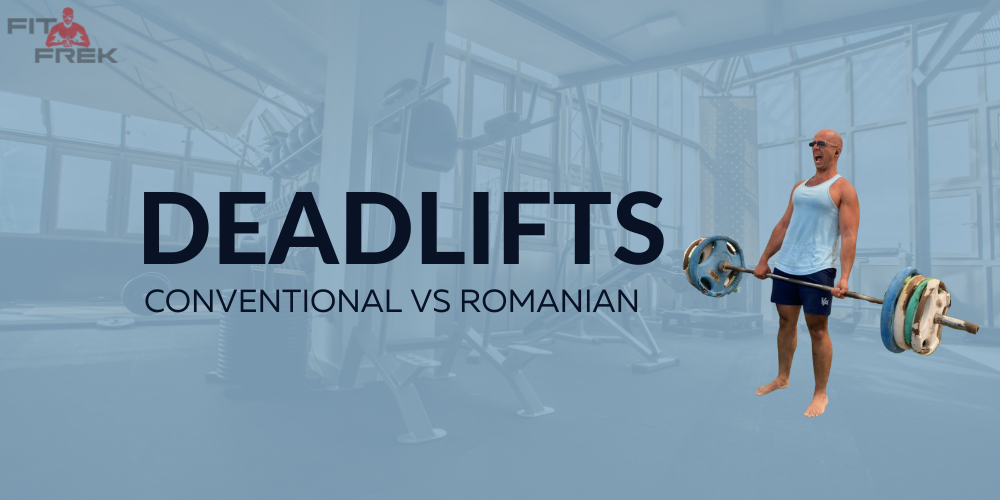
Conventional deadlifts start from the floor. Knee and hip bend create the start position, while body proportions affect how much of each is needed. The bar's fixed height defines the range.
Romanian deadlifts start upright. Unlock the knees, push the hips back and keep the bar close until the controlled hinge ends; hamstring length, proportions and trunk control set that endpoint. It is not a failed floor pull: it is a top-down hinge with a more constant knee angle and usually less knee contribution.
The gluteus maximus and hamstrings contribute to hip extension, while the trunk musculature resists unwanted movement under load. The quadriceps contribute more clearly when greater knee extension is required. The lats and upper back help keep the bar close; they are not pulling the bar like a row.
Lee and colleagues compared conventional and Romanian deadlifts in twenty-one men. The conventional version produced more knee and ankle torque plus greater rectus-femoris and slightly greater gluteus-maximus excitation. Biceps-femoris excitation was not clearly different.
Participants used the same absolute load—70% of Romanian-deadlift 1RM—for both lifts and lowered both variations to the floor. Relative intensity therefore differed, and the Romanian technique used more range and knee flexion than many coaches prescribe. The findings describe that protocol, not every lifter's exercises.
A six-week trial comparing eccentrically biased Romanian deadlifts with Nordic hamstring exercise found measurable hamstring architectural and cross-sectional changes in both groups. That supports the RDL as a trainable hamstring exercise, but it was not a comparison with conventional deadlifts.
Research in trained men performing deadlifts at 90% 1RM shows that set configuration changes force, power and fatigue. Heavy floor pulls should be programmed around rep quality. These limitations do not create one mandatory rep range; they support stopping before technique and output deteriorate.
Bar over mid-foot. Stand with the bar close enough that it can travel vertically without moving around the knees. Use a stance that lets the knees and hips share the setup.
Hands outside the legs. Hinge down, bend the knees as needed and grip the bar. Keep pressure through the whole foot instead of rocking toward the toes.
Brace and remove slack. Build abdominal pressure, set the upper back and pull gently against the bar before it leaves the floor. Do not jerk a loose system.
Push the floor away. Extend the knees and hips while keeping the bar close. Finish tall without leaning back or forcing the shoulders behind the hips.
Hinge, then bend knees. Guide the bar down close to the legs. Reset when the next repetition cannot begin from the same stable position.
Hold bar against thighs. Stand tall with a stable grip, soft knees and the bar close. Begin from pins or deadlift the first repetition safely into position.
Maintain a soft knee. Move the hips behind you while the torso inclines. Do not turn the repetition into a squat by driving the knees forward.
Slide along the legs. Use the lats and grip to keep the load over the mid-foot. A drifting bar increases the moment arm and changes the task.
End before position changes. Finish the descent when additional range would require pelvic or spinal position to change. The bar does not need to touch the floor.
Stand without leaning back. Reverse the hinge and finish tall. Keep the knees softly bent and use the same controlled path on every repetition.
These are practical starting ranges, not physiological laws. Use lower repetitions when heavy floor-pull skill is central and moderate repetitions when maintaining a hinge under longer sets is useful. Avoid adding load when the bar drifts, the start changes or the Romanian-deadlift endpoint moves simply to reach lower.
Choose conventional deadlifts when the goal includes practicing and progressing a floor pull with substantial whole-body demand. Choose Romanian deadlifts when you want controlled hip-hinge and hamstring work from a top-down start.
Both can belong in one program, but they do not need to. Match the exercise, load and set structure to the adaptation you can measure and recover from. The available evidence explains different mechanics; its limitations do not establish a universal strength or hypertrophy winner.
FITFREK WEEKLY
Early testing notes, formula changes, and verified supplement price moves — filtered into one useful email.